Partly right. The critique you read is real and pretty strong, but "Dunning-Kruger isn't real" overstates it a bit.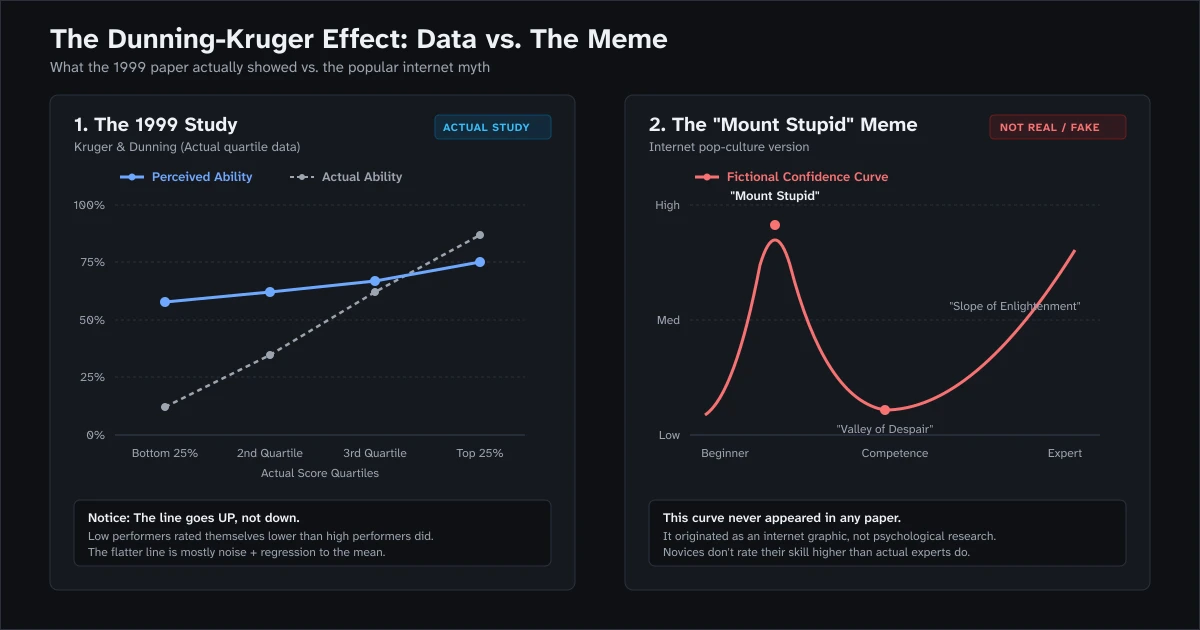
What the Critique Says
The famous 1999 study sorted people into quartiles by test score and then plotted how well each group thought they did. The bottom group overestimated a lot and the top group slightly underestimated.
The problem is that you get almost exactly that pattern from random data. If people's self-estimates are only loosely tied to their real ability (noise), and everyone tends to rate themselves a bit above average (a well-known bias), then the low scorers will automatically look overconfident and the high scorers will look underconfident. That's regression to the mean plus the better-than-average effect, no special "incompetent people can't see their incompetence" mechanism needed.
The "autocorrelation" version you probably saw (popularized by a 2022 blog post by Blair Fix, building on earlier work by Nuhfer and others) is related: if you plot "overconfidence" (perceived minus actual score) against actual score, actual score appears on both sides of the comparison, so a negative relationship is baked in even with pure noise.
What Still Holds Up
When researchers use better statistical methods, results are mixed. Some studies, like one by Gignac and Zajenkowski on intelligence, found little to no evidence for the specific effect. Others find a smaller real version: low performers do tend to be somewhat worse at judging their own performance, not just noisier.
So there may be a modest real effect, but much of the dramatic original graph is a statistical artifact.
What's Definitely Not Real
The meme version, the "Mount Stupid" curve where beginners think they're experts, then crash, then slowly climb, isn't from the research at all. Even in the original study, the least skilled people rated themselves lower than the most skilled people did. They just overestimated where they stood.
Summary
The classic Dunning-Kruger graph is mostly explained by statistics, the pop-culture version is made up, and whether a genuine but smaller effect exists is still debated.